

This post contains affiliate links. If you buy through them, we may earn a small commission at no extra cost to you.
“What weight dumbbells should I start with?” is one of the most common questions new lifters ask. Pick too light and you will not challenge your muscles. Pick too heavy and your form breaks down, which raises your risk of strain and makes progress slower. The good news: there is a simple way to find the right starting weight, and it does not require a gym or a trainer.
This guide explains how to choose dumbbell weight for beginners, gives typical starting ranges for different exercises, and shows when it is time to move up.
The Simple Rule: Use the “Two Reps Left” Test
The best starting weight is one you can lift for your target number of reps with good form while feeling like you could do about two more. That is it.
- If you finish 10 reps and could easily do 8 more, the weight is too light.
- If you cannot finish 10 reps without your form falling apart, it is too heavy.
- If reps 8, 9 and 10 feel challenging but clean, you are in the right range.
This approach works for any body type, age, or fitness level, because it is based on how the weight feels for you, not on a chart.
Why One Weight Is Rarely Enough
Your muscles are not all the same strength. Your legs and back can handle much more than your shoulders or the small muscles in the back of your arms. That is why most beginners do best with at least two or three different weights:
- A light pair for shoulder raises, triceps work and warm-ups.
- A medium pair for curls, presses and rows.
- A heavier pair for squats, lunges and deadlift-style moves.
A light neoprene pair is an easy, low-cost place to start, especially for shoulder and arm exercises.
Yes4All 5 lbs Dumbbells Neoprene with Non Slip Grip – Great for Total Body Workout – Total Weight: 10 lbs (Set of 2)
A light neoprene pair with a non-slip grip, good for shoulder raises, arm work and warm-up sets.
$11.50 Shop Now
Typical Starting Points by Exercise Type
Everyone is different, so treat these as rough starting ideas, then use the “two reps left” test to adjust:
- Lateral and front raises: Start very light. These isolate the shoulders, which tire fast.
- Triceps extensions and kickbacks: Light to light-medium.
- Biceps curls: Light-medium. You should be able to curl without swinging your body.
- Overhead press: Medium. Press straight up without arching your lower back.
- Bent-over rows: Medium to heavier. Back muscles are strong, so many beginners find rows easier than presses.
- Goblet squats and lunges: Medium to heavy. Legs can usually handle the most weight.
- Romanian deadlifts: Medium to heavy, once you have practiced the hip hinge with light weight first.
When in doubt, start lighter. You can always pick up a heavier pair next set. You cannot undo a set done with bad form.
How to Test Your Weights at Home
Here is a quick 15-minute test session to find your numbers:
- Warm up for 5 minutes with marching, arm circles and bodyweight squats.
- Pick one exercise, such as biceps curls, and grab your lightest pair.
- Do 10 slow, controlled reps. Rate how hard it felt.
- Rest one minute. If it felt easy, try the next weight up.
- Stop at the weight where the last two or three reps are hard but clean.
- Write the weight down, then repeat for a press, a row and a squat.
Now you have a personal starting chart, which beats any generic guideline.

CAP Barbell Neoprene Dumbbell Weights Pairs & Sets | Multiple Colors
Neoprene-coated pairs in multiple options, easy on hands and floors for home training.
$14.99 Shop Now
Form Comes First
Good form keeps the work on the muscles you are training. Watch for these signs that a weight is too heavy:
- Swinging or using momentum to lift.
- Arching your lower back during presses or curls.
- Shrugging your shoulders up toward your ears.
- Rushing the lowering phase instead of controlling it.
- Holding your breath for the whole set.
Aim for about two seconds up and two to three seconds down. Breathe out as you lift and in as you lower. A mirror or a quick phone video can help you spot problems.
When to Increase the Weight
Use a simple “double progression” approach. Pick a rep range, such as 8 to 12 reps:
- Start at a weight where you can do 8 good reps.
- Each session, try to add a rep or two.
- Once you can do 12 clean reps for all your sets, move up to the next weight.
- Drop back to 8 reps with the new weight and build up again.
This keeps progress steady and stops you from jumping weights too soon. Smaller muscles, like shoulders, often progress more slowly. That is normal.

CAP Barbell Coated Dumbbell Weight | Multiple Options Pairs & Sets
Coated dumbbells sold in several options, a practical way to add a medium or heavier pair as you progress.
$32.19 Shop Now
A Simple Beginner Dumbbell Routine
Try this two or three times a week, with a rest day in between:
- Goblet squat: 3 sets of 10
- Dumbbell row (each arm): 3 sets of 10
- Overhead press: 3 sets of 8–10
- Romanian deadlift: 3 sets of 10
- Biceps curl: 2 sets of 10–12
- Triceps extension: 2 sets of 10–12
Rest about 60 to 90 seconds between sets. The whole routine takes roughly 30 to 35 minutes.
Fixed Pairs or a Full Set?
If you are just starting, two or three fixed pairs cover most needs. As you get stronger, you will want more steps between weights, and a rack keeps them organized and off the floor. A full set costs more up front but saves you from buying pairs one by one.
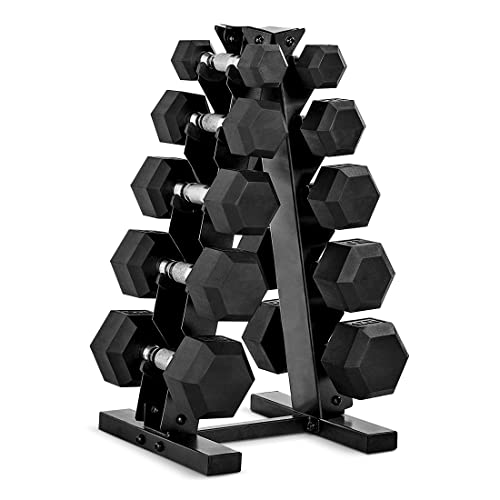
CAP Barbell Rubber Coated Dumbbell Weight Set with Vertical Rack | 100 lb, 150 lb, and 210 lb Options
A rubber-coated dumbbell set with a vertical rack, offered in several total-weight options for a growing home gym.
$189.99 Shop Now
Quick FAQ
Are 5 lb dumbbells too light for beginners?
Not for everyone. Light dumbbells work well for shoulder raises, arm isolation moves, and people returning after a long break. Most beginners will want heavier pairs for squats and rows too.
Should men and women start with different weights?
Start with the test, not with labels. Your current strength matters more than any category.
How many reps should I do?
For general strength and muscle tone, 8 to 12 reps per set is a good beginner range.
How often should I lift?
Two or three full-body sessions per week is plenty to start, with at least one day off between them.
Is muscle soreness normal?
Mild soreness a day or two after new exercises is common. Sharp or joint pain is a signal to stop and check your form or lower the weight.
The Bottom Line
The right dumbbell weight for a beginner is the one that lets you finish your reps with clean form and about two reps left in the tank. Start with a light, medium and heavier pair, test each exercise, write down your numbers, and use double progression to move up. Lift with control, stay consistent, and the weights will climb on their own.


