
This post contains affiliate links. If you buy through them, we may earn a small commission at no extra cost to you.
A rowing machine works your legs, core, back and arms in one smooth motion, and it is low impact on your joints. But rowing is also a skill. Many beginners pull mostly with their arms, rush the return, or crank the resistance to the max, and end up tired, sore in the wrong places, and frustrated.
The good news is that most rowing machine mistakes are easy to fix once you know what to look for. This guide covers correct rowing form, the most common beginner mistakes, and a short practice session to lock in good habits.
The Four Parts of a Rowing Stroke
Every stroke has four phases. Learning them by name makes it easier to spot what is going wrong.
- The catch: You are forward on the seat, shins close to vertical, arms straight, back tall and leaning slightly forward from the hips.
- The drive: Push through your legs first. As your legs straighten, swing your upper body back slightly, then finish by pulling the handle toward your lower ribs.
- The finish: Legs straight, shoulders slightly behind your hips, handle close to your body, elbows past your sides.
- The recovery: Reverse the order: arms extend, body leans forward from the hips, then knees bend and you slide back to the catch.
Rowers often remember the drive as “legs, body, arms” and the recovery as “arms, body, legs.”
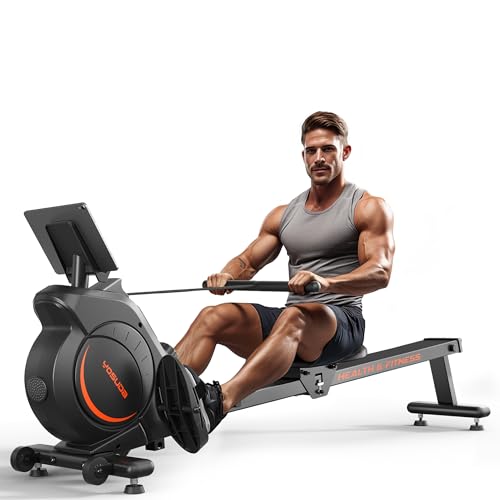
YOSUDA Magnetic/Water Rowing Machine for Home – Rower Machine Use with Bluetooth, App Supported, Rowing Machine for Beginners to Athletes, Comfortable Seat Cushion
A magnetic/water rowing machine for home, a solid way to practice full-body, low-impact cardio.
$189.99 Shop Now
Mistake 1: Pulling With Your Arms First
Your legs are the strongest part of the stroke and should do most of the work. When you pull with your arms first, your smaller muscles tire quickly and you lose power.
Fix: Practice “legs only” strokes. Keep your arms straight and body still, and just push with your legs for 10 strokes. Feel how much the handle moves from the legs alone.
Mistake 2: Rushing the Recovery
Many beginners fly back up the slide as fast as they pushed away. This makes your stroke choppy and tiring, and it can throw off your rhythm.
Fix: Think of a ratio of about one count out on the drive, two counts back on the recovery. The drive is powerful; the recovery is a controlled reset.
Mistake 3: Bending the Knees Too Early on the Recovery
If your knees bend before your hands pass over them, the handle has to go up and over your knees. This creates an awkward, jerky motion.
Fix: On the way back, extend your arms fully and lean forward from the hips first. Only bend your knees once the handle has cleared them.
Mistake 4: Rounding Your Back
Slumping at the catch or hunching at the finish puts extra stress on your lower back.
Fix: Sit tall with your chest proud, and hinge from your hips instead of curling your spine. Keep your core gently braced throughout the stroke.
Mistake 5: Leaning Too Far Back at the Finish
Lying back dramatically at the end of the drive wastes energy and slows your return.
Fix: Aim for a slight lean, roughly like the hands of a clock pointing to 11. Your core should hold you there, not collapse.
Mistake 6: Using Maximum Resistance
Higher resistance does not automatically mean a better workout. On many machines, very high resistance turns each stroke into a slow, heavy pull that strains your back and arms before your legs and lungs get worked.
Fix: Start at a low-to-moderate setting. Focus on smooth, connected strokes first, then add resistance gradually.

Sunny Health & Fitness Compact Full-Motion Rowing Machine w/Adjustable Resistance, Low-Impact Full-Body Workout Rower w/Long Slide Rail, Space-Saving Design, Optional Free SunnyFit App Connection
A compact full-motion rowing machine with adjustable resistance, designed for low-impact workouts at home.
$227.61 Shop Now
Mistake 7: Gripping the Handle Too Tightly
A death grip tires your forearms and pulls tension into your shoulders.
Fix: Hold the handle with relaxed fingers, wrists flat, and thumbs lightly wrapped. Think “hooks,” not “fists.”
Mistake 8: Shrugging Your Shoulders
Lifting your shoulders toward your ears during the pull is common when people try to muscle the handle in.
Fix: Keep your shoulders down and relaxed. Pull the handle toward your lower ribs, not your chin.
A 15-Minute Form Practice Session
Try this before your regular workouts for the first couple of weeks:
- 3 minutes: Easy rowing to warm up.
- 2 minutes: Legs only, arms straight, body still.
- 2 minutes: Legs and body, no arm pull.
- 2 minutes: Full stroke, focusing on “legs, body, arms.”
- 3 minutes: Full stroke with a slow, controlled recovery (one count out, two counts back).
- 3 minutes: Easy cool-down.
If you can, record a short side-view video of yourself. It is one of the fastest ways to spot what you cannot feel.
Setup Tips Before You Row
- Foot straps: Strap across the widest part of your foot so you can push through your whole foot.
- Space: Leave room behind the rail and around the machine.
- Flooring: A flat surface and an equipment mat help with stability and noise.
- Shoes: Wear secure athletic shoes rather than loose slippers.
Quick FAQ
What muscles does a rowing machine work?
Rowing works your legs, glutes, core, back, shoulders and arms, with the legs doing the largest share.
Is rowing bad for your back?
Rowing with poor form can strain your back. With a tall posture, hip hinge and leg-driven stroke, many people find it comfortable. If you have a back condition, check with a professional first.
How long should beginners row?
Start with 10 to 15 minutes, focusing on form, and build toward 20 to 30 minutes over a few weeks.
What resistance level should I use?
Low to moderate at first. Smooth technique matters more than heavy resistance.
Why do my hands or forearms get tired?
You are likely gripping too hard or pulling too much with your arms. Relax your grip and drive with your legs.
The Bottom Line
Most rowing machine mistakes come down to sequence and pacing. Drive with your legs first, follow with your body and arms, and take your time on the recovery. Keep resistance moderate, posture tall and grip relaxed. Spend a couple of weeks practicing good form, and every workout after that will feel smoother and more effective.


