

This post contains affiliate links. If you buy through them, we may earn a small commission at no extra cost to you.
A jump rope is one of the cheapest and most compact pieces of cardio equipment you can own. It fits in a drawer, works almost anywhere, and can give you a real workout in just a few minutes. But there are more choices than you might expect: speed ropes, beaded ropes, weighted ropes, cordless ropes and smart ropes with counters and apps.
This guide explains how to choose a jump rope by type, length, handle and features, so the one you buy fits your goals and your space.
Start With Your Goal
Before comparing ropes, decide what you mostly want to do:
- Learn the basics and build a habit: A simple, adjustable rope with a counter can help you stay motivated.
- Get faster or learn tricks: A lighter, thinner speed rope spins quickly.
- Jump with low ceilings or limited space: A cordless rope lets you go through the motion without a full rope swing.
- Track progress: A smart rope can count jumps and time, and some sync to an app.
Types of Jump Ropes
Basic PVC or speed ropes
These have a thin cable or plastic cord and spin quickly. They are good for everyday cardio and for learning rhythm once you have the basics down. Thinner ropes can sting a bit if they hit your legs, which is part of learning.
Beaded ropes
Beaded ropes are made from plastic segments. They are slower and easier to see and feel, which helps beginners with timing.
Weighted ropes
Heavier ropes or handles add more upper-body effort and slow the rope down. They can be a good change of pace but are usually not the best first rope.
Cordless ropes
Cordless ropes use short weighted balls or tethers instead of a full rope. You can practice the jumping motion in small rooms or under low ceilings without catching the rope on furniture.
Smart ropes
Smart ropes add a counter in the handle, a display, or an app connection. Many are adjustable and some include cordless attachments. If you like numbers and goals, a counter is a simple motivation boost.
RENPHO Smart Jump Rope – APP Data Storage & Tracking & Analysis, Tangle-Free Jumping Rope for Men, Women, Skipping Rope with Counter, Adjustable workout Jump Ropes for Crossfit, Gym, MMA
A smart jump rope with app tracking and a tangle-free design for people who like logging every session.
$18.99 Shop Now
How to Choose the Right Length
Length matters more than almost anything else. Too long and the rope drags and slows you down. Too short and it catches your feet.
A common way to check length:
- Stand on the middle of the rope with one foot.
- Pull the handles straight up along your body.
- For beginners, the tops of the handles (or the point where the rope meets them) usually reach around armpit to chest height.
- As you get more skilled, many jumpers shorten the rope slightly for faster spins.
Most adult ropes are adjustable, so pick one you can shorten easily. Check the product details for how adjustment works.
Handles: Grip and Comfort
- Length: Longer handles give more control; shorter ones feel lighter.
- Grip: Foam or textured grips help when your hands get sweaty.
- Bearings: Ropes with bearings in the handles tend to spin more smoothly.
- Weight: Light handles for speed; heavier handles for a slower, more muscular feel.
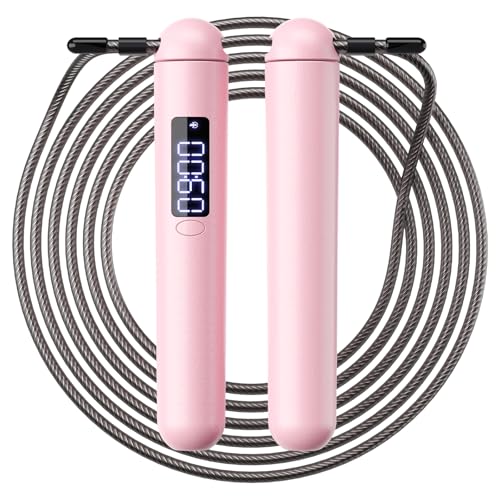
Smart Jump Rope with Counter – Adjustable High Speed Skipping Rope for Adults, LED Display with 4 Modes, Calorie Tracker for HIIT, Boxing, Crossfit & Home Workouts
An adjustable smart jump rope with a counter and LED display, an affordable way to track your jumps.
$8.99 Shop Now
Where You Jump Matters Too
The surface you jump on affects both comfort and how long your rope lasts.
- Best: A wood floor, rubber gym flooring, or an exercise mat.
- Okay: Low-pile carpet, though it can slow the rope.
- Avoid if possible: Rough concrete or asphalt, which wears ropes out quickly and is harder on your joints.
Check your ceiling height and clear the space around you. If either is limited, a rope with a cordless option is worth considering.

multifun Digital Jump Rope with Smart Counter & Timer – Adjustable Speed Skipping Rope for Fitness, Weight Loss, Boxing, MMA – Tangle-Free Ball Bearings & Anti-Slip Handles for Men, Women, Kids
A digital jump rope with a smart counter, timer and adjustable-speed rope for everyday cardio.
$13.99 Shop Now
A Beginner Jump Rope Plan
If you are new, start with short intervals:
- Week 1: 30 seconds jumping, 30 seconds rest, repeat 6 times.
- Week 2: 40 seconds on, 20 seconds off, repeat 8 times.
- Week 3: 1 minute on, 30 seconds off, repeat 6 to 8 times.
- Week 4: Try 2-minute rounds with short breaks.
Stay light on the balls of your feet, keep jumps low, and turn the rope with your wrists rather than big arm circles.
Common Mistakes When Buying a Jump Rope
- Buying a rope that cannot be adjusted. Length is personal, and fixed ropes can be frustrating.
- Starting with a very heavy rope. It makes learning timing harder.
- Ignoring your space. Low ceilings and tight rooms may call for a cordless option.
- Paying for features you will not use. If you do not care about apps, a simple counter may be all you need.
Quick FAQ
What type of jump rope is best for beginners?
An adjustable rope that is not too light or too heavy. Beaded ropes and basic smart ropes with counters are both beginner-friendly.
Are smart jump ropes accurate?
Accuracy varies by model and by how consistently you jump. Treat the count as a helpful guide for tracking progress.
Can I jump rope in an apartment?
Yes, with care. Use a mat to soften landings and reduce noise, keep jumps low, and consider a cordless rope for low ceilings.
How long should a jump rope workout be?
Beginners can start with 5 to 10 minutes of intervals and build up over a few weeks.
What shoes should I wear?
Supportive athletic shoes with some cushioning. Avoid jumping barefoot on hard floors.
The Bottom Line
To choose a jump rope, start with your goal and your space, then focus on length, adjustability and comfortable handles. For most beginners, an adjustable rope with a counter is a smart first buy. Jump on a forgiving surface, start with short intervals, and build up gradually.


