
This post contains affiliate links. If you buy through them, we may earn a small commission at no extra cost to you.
Resistance bands and dumbbells are the two most common ways people start strength training at home. Both work. Both fit in a small space. But they feel different, cost different amounts, and suit different goals.
If you’re trying to decide which to buy first, this guide walks through the trade-offs so you can make a confident choice.
How Each One Works
Dumbbells use gravity. The weight stays the same through the whole movement, and the hardest part of each rep depends on your body position relative to the floor.
Resistance bands use stretch. The further you stretch a band, the harder it pulls back. That means the end of a movement usually feels harder than the start. Bands also let you pull in any direction, not just against gravity, because you can anchor them to a door, a post or your own feet.
Resistance Bands: Pros and Cons
What bands do well:
- Cheap to start. A full set usually costs less than a single pair of mid-weight dumbbells.
- Tiny to store. A whole set fits in a drawer or a backpack.
- Travel friendly. You can take them on trips and keep your routine going.
- Quiet. Nothing to drop on the floor, which matters in apartments.
- Versatile angles. With a door anchor you can do rows, presses and pulldowns from different directions.
Where bands fall short:
- Resistance is harder to measure precisely, so tracking progress takes more attention.
- Some exercises feel awkward until you learn the setup.
- Bands wear out over time and should be checked for nicks or cracks before each use.
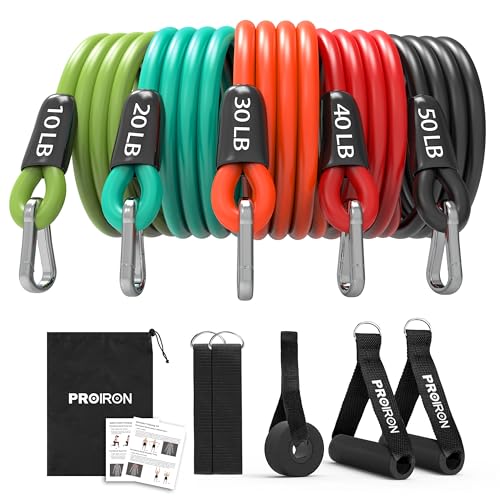
PROIRON Resistance Bands with Handles, Five-Rope Set
A tube band set with handles and a layered anti-breakage build for full-body strength work at home.
$27.99 Shop Now
Dumbbells: Pros and Cons
What dumbbells do well:
- Easy to understand. Pick it up, do the move. Most exercise videos and programs use them.
- Clear progress. Going from 10 to 12 pounds is an obvious, measurable step.
- Stable feel. The load is consistent, which many beginners find easier for learning form.
- Durable. A good pair can last for many years.
Where dumbbells fall short:
- You’ll eventually need several weights, and that adds up in cost and space.
- They’re heavy to move and not practical for travel.
- Dropping them can damage floors or bother neighbors, so a mat is a good idea.

Yes4All 5 lb Neoprene Dumbbells (Set of 2)
A light cast-iron pair with a neoprene coating and non-slip grip, good for first-time lifters.
$11.50 Shop Now
Which Is Better for Beginners?
There’s no single winner. The better pick depends on your situation:
- Choose bands first if your budget is tight, you live in a small space, you travel often, or you want gentle resistance for warm-ups and mobility.
- Choose dumbbells first if you like simple, measurable progress, plan to follow a standard strength program, or prefer a steady, predictable feel.
- Use both if you can. Many people use dumbbells for main lifts and bands for warm-ups, glute work and upper-back exercises.
Loop Bands vs Tube Bands
“Resistance bands” covers a few types, and it helps to know which one you’re buying:
- Mini loop bands are short, flat loops that go around your thighs or ankles. They’re popular for glute and hip exercises and warm-ups.
- Tube bands with handles feel more like using cables at a gym. They’re good for presses, rows and curls, especially with a door anchor.
- Long loop bands are bigger continuous loops often used for assisted pull-ups and stretching.
For a first purchase, a set of mini loops plus a tube set with handles covers almost every beginner exercise.

WIKDAY Resistance Loop Bands, Set of 5
Five 12-inch loop bands in different thicknesses for leg, glute and warm-up exercises.
$4.99 Shop Now
How to Pick the Right Dumbbell Weight
Start lighter than you think. You should be able to finish your target reps with good form and feel like you could do a couple more. Many beginners do well starting with a light pair for shoulder and arm work and a heavier pair for squats, deadlifts and rows.
When a weight starts to feel easy for all your sets, it’s time to move up. That’s the point where a multi-weight set or a rack becomes worth it.
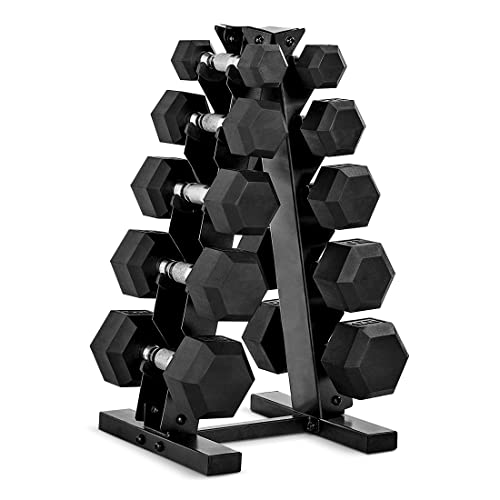
CAP Barbell Rubber Coated Dumbbell Set with Vertical Rack
Pairs of rubber hex dumbbells with an A-frame rack, for anyone ready to build a real home weight setup.
$189.99 Shop Now
Sample Beginner Workout: Bands and Dumbbells Side by Side
Here’s one simple full-body routine with a band version and a dumbbell version of each move. Do 2–3 rounds of 10–12 reps, two or three times a week.
- Squat: stand on a tube band and hold the handles at your shoulders, or hold one dumbbell at your chest (goblet squat).
- Row: anchor a band in a door at chest height and pull, or hinge forward and row a dumbbell with one arm.
- Chest press: anchor the band behind you and press forward, or lie on the floor and press dumbbells up.
- Hip hinge: stand on the band and do a deadlift motion, or do a Romanian deadlift with dumbbells.
- Glute bridge: loop a mini band above your knees, or rest a dumbbell on your hips.
- Overhead press: stand on the band and press up, or press dumbbells overhead.
Rest about a minute between exercises. Focus on slow, controlled reps rather than speed.
Safety Tips for Both
- Inspect bands before each workout and replace any with tears, thin spots or sticky patches.
- Anchor bands securely and make sure doors are closed and locked when using a door anchor.
- Keep dumbbells on a rack or mat when not in use so nobody trips over them.
- Warm up for a few minutes before lifting, and stop any exercise that causes sharp pain.
Quick FAQ
Can you build muscle with resistance bands?
Bands can provide enough challenge for many beginners and intermediate exercisers, especially when you use heavier bands or combine several. Progress depends on working hard enough and staying consistent.
Are bands safer than dumbbells?
Each has its own risks. Bands can snap if worn or anchored poorly, and dumbbells can be dropped. Following basic safety habits makes both reasonable choices for home training.
How many dumbbells do I need to start?
One light pair and one moderate pair is enough for a basic full-body routine. Add more as you get stronger.
Should I buy adjustable dumbbells instead?
Adjustable dumbbells save space if you know you’ll keep progressing. If you’re testing the waters, a single fixed pair or a band set is a lower-cost start.
The Bottom Line
Resistance bands win on price, storage and travel. Dumbbells win on simplicity and easy-to-track progress. If you can only buy one, pick bands for a small space or tight budget and dumbbells if you want a straightforward strength routine. If you can buy both, a light dumbbell pair plus a band set gives you a flexible home setup that covers nearly every beginner exercise.


