
This post contains affiliate links. If you buy through them, we may earn a small commission at no extra cost to you.
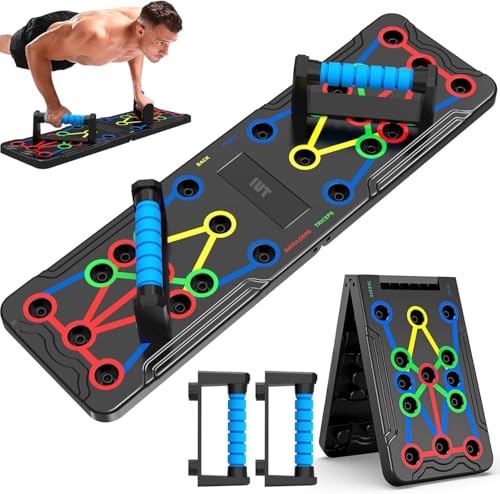
A push-up board looks simple: a flat, foldable board covered in colored slots, with two handles you can move around. But those colors aren’t just decoration. Each one points you to a hand position that shifts the work toward a different muscle group. Once you understand the system, a single board gives you dozens of push-up variations in a few square feet.
Here’s how the color-coded positions work, how to use a push-up board safely, and a simple workout to get started.
What Is a Push-Up Board?
A push-up board is a plastic platform, usually folding, with rows of slots for two removable handles. You click the handles into a pair of matching slots, get into a push-up position and train. The handles raise your hands off the floor, which can feel easier on the wrists than flat-palm push-ups and lets you go a little deeper.
Many boards also come in kits with extras such as resistance bands, a jump rope or an ab wheel, turning the board into a compact upper-body station.
15-in-1 Push Up Board
Color-coded multi-position push-up board for chest, shoulders and triceps.
$19.99 Shop Now
How the Color-Coded Positions Work
Most push-up boards use color groups to show which muscles each hand position emphasizes. The exact colors vary between brands, so always check the legend printed on your board or in the manual. In general, the positions follow the same logic:
- Wide positions put more emphasis on the chest.
- Shoulder-width positions angled forward bring the shoulders into play more.
- Narrow positions close to the center shift more work to the triceps.
- Positions set back or angled are often labeled for the back and upper body stability.
The board just makes these grip changes easy to repeat. Instead of guessing where to put your hands, you click into the same color every time, which helps you track progress and keep workouts consistent.
Remember that every push-up still works several muscles at once. Your chest, shoulders, triceps and core all help in every variation. The color system just changes the balance.
How to Do a Push-Up on the Board
- Unfold the board on a flat, non-slip surface.
- Click both handles firmly into two slots of the same color, one on each side.
- Grip the handles and step your feet back into a plank. Your body should form a straight line from head to heels.
- Brace your core and squeeze your glutes.
- Lower your chest toward the board with control, keeping elbows at a comfortable angle rather than flared straight out.
- Press back up until your arms are straight, without locking your elbows hard.
If full push-ups are too hard, start on your knees with the same positions. You’ll still train the same muscles, just with less body weight.

MQRW Push Up Board with 20 Accessories
Push-up board plus pilates bar, resistance bands and ab roller.
$39.99 Shop Now
A 15-Minute Push-Up Board Workout
Do each move for the reps listed, rest 30 to 45 seconds between sets, and complete the circuit twice.
- Chest position (wide): 8 to 12 reps
- Shoulder position: 8 to 10 reps
- Triceps position (narrow): 6 to 10 reps
- Back position: 8 to 10 reps
- Plank hold on the handles: 20 to 40 seconds
Choose a number of reps where the last one or two feel hard but your form stays clean. Write down the colors and reps you used so you can beat them next time.
How to Progress
- Move from knee push-ups to full push-ups.
- Add 1 or 2 reps per set each week.
- Slow down the lowering phase to three seconds.
- Add a third round.
- Elevate your feet on a low step for more challenge once standard push-ups feel easy.
Train two or three times a week on non-consecutive days so your upper body has time to recover.
Common Mistakes
- Sagging hips: keep your core tight and your body in a straight line.
- Loose handles: always check both handles are locked into their slots before every set.
- Mismatched colors: using two different color slots puts uneven stress on each side.
- Flaring elbows: keep them at a comfortable angle to protect your shoulders.
- Bouncing reps: slow, controlled reps build more strength than fast, sloppy ones.
Choosing a Push-Up Board
When comparing boards, look at:
- Number of positions. More slots means more variety, but even simpler boards cover the main muscle groups.
- Folding design. A foldable board stores easily under a bed or in a closet.
- Non-slip base. The board should stay put on hard floors.
- Handle comfort. Padded or textured handles are easier to grip.
- Included accessories. Bands and other extras can make the kit more useful for full-body workouts.

LALAHIGH 36-in-1 Push Up Board
Push-up board with ab roller wheel and resistance bands for full-body training.
$41.99 Shop Now
Who a Push-Up Board Is For
A push-up board is a good fit for beginners who want guidance on hand placement, people with small spaces who want an upper-body tool that folds flat, and anyone who gets bored with standard push-ups and wants more variety. It’s also a budget-friendly way to start strength training at home before investing in heavier equipment.
Quick FAQ
Are push-up boards good for beginners?
Yes. The marked positions make it easy to repeat the same grip each time, and you can do every variation from your knees until you build enough strength for full push-ups.
Can a push-up board replace weights?
For many beginners, a push-up board can be the main upper-body tool for months. Over time, you may want to add bands or dumbbells for pulling movements and heavier pressing.
Is it easier on the wrists?
Holding handles keeps your wrists straighter than pressing flat palms into the floor, which many people find more comfortable. If you have wrist pain, start slowly and stop if it gets worse.
The Bottom Line
A push-up board takes the guesswork out of hand placement. The color-coded slots point you to positions that emphasize your chest, shoulders, triceps or back, so you can build a balanced upper-body routine with one simple tool. Check your board’s legend, lock the handles in securely, start with the 15-minute workout above and add reps over time.


