
This post contains affiliate links. If you buy through them, we may earn a small commission at no extra cost to you.
Your first pull-up is one of the most satisfying milestones in home fitness, and also one of the hardest. Most people can’t do one on day one, and that’s completely normal. Pull-up assist bands close the gap by taking some of your body weight off the bar, so you can practice the real movement and build strength rep by rep.
Here’s how assist bands work, how to choose the right one, and a simple plan to go from zero to your first unassisted pull-up.
How Pull-Up Assist Bands Work
An assist band is a long, thick loop of rubber. You loop it over your pull-up bar, pull one end through the other so it locks in place, and then place your foot or knee in the bottom of the loop.
When you hang from the bar, the stretched band pushes up on you. The help is strongest at the bottom, where pull-ups are hardest, and lighter near the top, where you’re strongest. That means you still do most of the work with your back and arms, just with a boost where you need it.
The thicker the band, the more help it gives. As you get stronger, you switch to thinner bands until you no longer need one at all.
Amazon Basics Pull Up Bands
Affordable assist bands in different strengths to help you train pull-ups.
$6.64 Shop Now
Choosing the Right Band
Assist bands are usually sold by color and resistance level. A few simple rules make choosing easier:
- Start with more help than you think you need. If you can only grind out one ugly rep, the band is too light. You should be able to do 5 to 8 clean reps.
- Get more than one band. A set lets you step down gradually instead of making a big jump.
- Combine bands if needed. Two bands looped together give more assistance for heavier or newer lifters.
- Check the length. Long loop bands work best for pull-ups because they reach your foot or knee comfortably.
Long loop bands are also useful beyond pull-ups. You can use them for stretching, banded push-ups, rows and shoulder warm-ups, so they earn their spot in a small home gym.

LEEKEY Resistance Bands
Long loop bands for pull-up assist, stretching and strength training.
$16.99 Shop Now
How to Do a Band-Assisted Pull-Up
- Loop the band around the center of your bar and pull it through itself so it’s secure.
- Stand on a sturdy step or chair, grab the bar with hands slightly wider than your shoulders, palms facing away.
- Place one foot or one knee in the bottom of the band, then carefully step off the support.
- Start from a full hang with arms straight. Pull your shoulder blades down and back first.
- Pull your chest toward the bar until your chin clears it.
- Lower slowly for two to three seconds until your arms are straight again.
Using your foot gives slightly more stretch, and so more help, than using your knee. Pick whichever feels more stable and stick with it so you can track progress fairly.
A 4-Week Plan to Your First Pull-Up
Train pull-ups two or three times a week with at least one rest day between sessions. Each session takes about 15 to 20 minutes.
Weeks 1 and 2: Build the Base
- Band-assisted pull-ups: 3 sets of 5 to 8 reps with a band that lets you keep good form.
- Dead hang: 3 holds of 15 to 30 seconds, no band, to build grip strength.
- Scapular pulls: 2 sets of 8. Hang from the bar and pull your shoulder blades down without bending your arms.
Week 3: Less Help, More Control
- Band-assisted pull-ups: 3 sets of 5 to 8 with the next lighter band if you managed 8 reps last week.
- Negative pull-ups: 3 sets of 3. Jump or step to the top position, then lower yourself as slowly as you can, aiming for 3 to 5 seconds.
- Dead hang: 3 holds of 30 seconds.
Week 4: Test Yourself
- Warm up with 2 easy sets of band-assisted pull-ups.
- Try one unassisted pull-up with full effort.
- If you don’t get it yet, finish with 3 sets of the lightest band you can handle and 3 slow negatives. Keep repeating week 3 and 4 until it clicks.
Everyone progresses at a different pace depending on body weight, experience and consistency. Some people need a few weeks, others a few months. Stick with the plan and the lighter bands will start feeling easy.
Adjustable Assistance for Steady Progress
If you want fine control over how much help you get, an adjustable assist system lets you change the support without swapping between separate loop bands. That can make it easier to step down in small amounts as you get stronger.
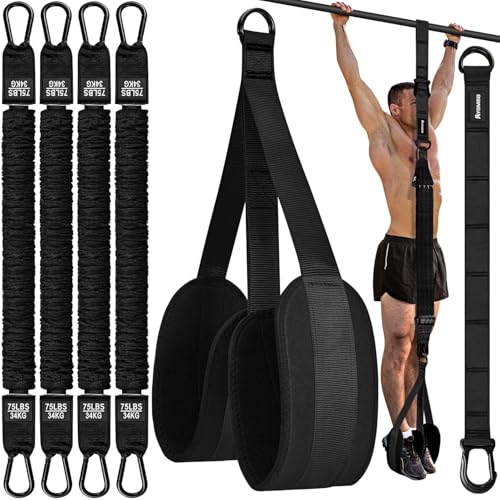
Adjustable Pull Up Assistance Bands
Heavy-duty adjustable assist system for pull-up bar workouts.
$29.97 Shop Now
Common Mistakes
- Using too much momentum: swinging or kicking turns the exercise into a bounce. Keep your body still.
- Half reps: start from straight arms and finish with your chin over the bar.
- Dropping fast: the lowering part builds a lot of strength, so control it.
- Staying on the same band forever: once you can do 8 clean reps, step down.
- Training every day: your back and arms need recovery to get stronger.
Safety Tips
Check your bands for small tears or cracks before each session, and replace any that look worn. Make sure your pull-up bar is installed securely and rated for your weight. Step into and out of the band carefully using a stable step, and keep the band away from your face when you get on and off.
The Bottom Line
Pull-up assist bands are an inexpensive, space-saving way to work toward your first real pull-up at home. Pick a band that lets you do clean reps, train two or three times a week, add negatives and dead hangs, and step down to lighter bands as you get stronger. Before long, you’ll be pulling your chin over the bar on your own.